

The Re-Pricing of an Icon
For fifty years, the CN Tower has been the undisputed anchor of Toronto's identity. It was a simple, monolithic data point on the skyline—a fixed variable against which everything else was measured. Its value was its height, its view, and its singular, dominant presence. But an asset's value is never static. It's constantly being re-priced by market forces, new competition, and shifts in public sentiment. Today, the CN Tower is undergoing a fundamental re-evaluation, driven not by a single event, but by a convergence of physical, cultural, and digital pressures.
The most tangible challenge comes from 1,200 metres away, at One Yonge Street. There, the Pinnacle SkyTower is methodically climbing towards its 106-storey peak. The developer, Pinnacle International, and its architect, David Pontarini, frame this as a symbolic partnership—a new titan rising to "partner up with the CN Tower." The numbers, however, suggest less of a partnership and more of a direct challenge. The CN Tower's main observation deck sits at 346 metres; the SkyTower is set to top out at approximately 350 metres. For the first time, the definitive `CN Tower view` will be rivaled by a residential structure.
This isn't just about one building. It's about a strategy. The SkyTower is the centerpiece of a multi-phase development that has already delivered a 65-storey tower and has a 95-storey tower approved. A new proposal submitted just last month (October 15th, to be precise) aims to add two more towers of 80 and 85 storeys on the adjacent south lands. This would bring the total to 4,912 new dwelling units and 487 hotel suites in a single concentrated block. The narrative is one of creating a "24/7 fully activated mixed-use... city," a talking point straight from the urban planning playbook. But when you look at the raw data, it looks more like a high-stakes bet on vertical density.
The city's planning department speaks of a collaborative process, of attending conferences to learn about "newly evolving best practices." I've looked at hundreds of these development proposals, and this kind of language often precedes a significant departure from original zoning. The SkyTower itself kept growing during construction, morphing from 95 to 106 storeys. This isn't organic growth; it's opportunistic expansion. The developer’s CEO, Michael De Cotiis, is described as someone who continually pushes height restraints. The question this raises is simple: at what point does a "fully activated city" become a saturated one? And what happens to the cultural primacy of a landmark when it's suddenly just the tallest building in a very crowded room?
An Asset's Intangible Value
While its physical dominance is being diluted, the CN Tower's symbolic value is becoming more potent—and more volatile. An asset’s worth isn’t just its physical specifications; it's also a function of the collective emotion and attention it commands. And for one week, that attention has been absolute. The Toronto Blue Jays are in Game 7 of the World Series, and the city is electric.
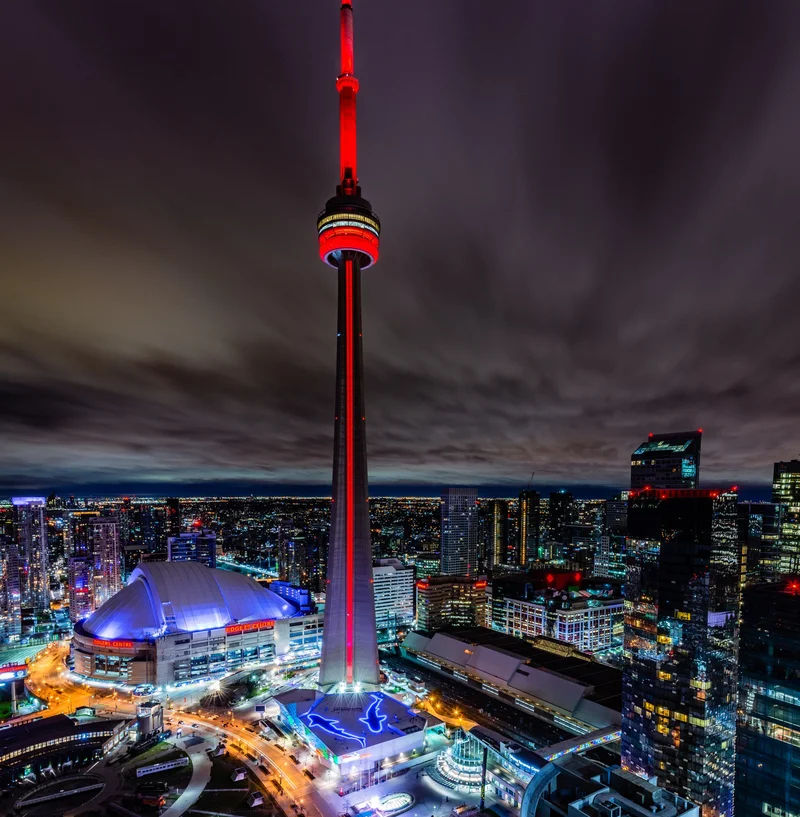
The numbers here are staggering. The cheapest tickets for the final game are trading for over $1,200. Premium seats are listed for more than $21,000, prompting the obvious question: How much do tickets cost for Game 7 of World Series? Los Angeles Dodgers vs Toronto Blue Jays. This isn't just about baseball; it's a city-wide emotional event, a release of 32 years of pent-up hope. And what is the visual shorthand for this collective experience? The `CN Tower at night`, lit up, serving as the backdrop for a potential historic victory. Its image is broadcast across the continent, inextricably linked to a moment of peak cultural relevance. This is an intangible asset—a brand association that no skyscraper developer can engineer. It's a reminder that a landmark's power is derived not just from concrete and steel, but from the human stories that unfold in its shadow.
But this symbolic power has a vulnerability. In the digital age, any highly visible asset becomes a target. Just this week, an AI-generated video of the `CN Tower on fire` went viral, racking up over 20 million views on Facebook. The 24-second clip was crude to a trained eye—the smoke drifted unnaturally, the details were off—but it was effective enough to fool many. The creator, who calls himself a "creator of viral moments," defended the video as "AI-generated art," an experiment in what the tools can create.
This is a disingenuous argument. I've analyzed market manipulation driven by false reports for years, and the mechanics here are eerily similar: use a trusted, stable symbol to trigger an emotional, irrational response for engagement. The video wasn't art; it was an arbitrage play on public anxiety. While one expert suggested the creator should be charged with conveying false information to cause alarm (a charge carrying a potential two-year sentence), Toronto police confirmed they are not investigating. This highlights a critical regulatory gap. The technology for creating these fakes is advancing far faster than the legislation to govern it, which is why many experts argue the Facebook video of CN Tower on fire should have AI-generated content label, experts say. The CN Tower itself had to issue a formal statement confirming the video was a deepfake. How many times can an institution debunk a fiction before the fiction starts to erode trust in the institution itself?
The tower's identity is now a contested space. On one hand, it’s a beacon for a city's real-world triumphs. On the other, it’s a canvas for digital phantoms. It's like a blue-chip stock that has suddenly become a meme stock. Its fundamental value (its physical presence) is being overshadowed by market sentiment, driven by everything from championship baseball to deepfake videos. Its stability is being replaced by volatility.
An Asset Undergoing Re-Evaluation
For decades, the CN Tower's value proposition was simple: it was the tallest, the only, the definitive. That era is over. The analysis now requires a more complex calculus. Its physical dominance is being systematically eroded by a forest of supertall residential towers that treat its height not as a monument to be respected, but as a benchmark to be surpassed. Its symbolic power, while capable of reaching incredible peaks during moments of civic pride like the World Series, has also been proven to be frighteningly vulnerable to digital manipulation. The tower is no longer a fixed point of certainty. It has become a variable, its meaning and value fluctuating with the chaotic inputs of a city growing and a digital world that answers to no one. The landmark isn't gone, but its monopoly is broken.
标签: #cn tower