

When the numbers for Carvana's third quarter flashed across my screen, I honestly just sat back in my chair, speechless. It wasn't just the headline figures—a staggering $5.65 billion in revenue and 156,000 cars sold. We’ve seen growth stories before. No, this was different. This felt like a closing argument. For years, the debate has raged: is Carvana a tech company that happens to sell cars, or is it just a glorified dealership with a slick app?
The skeptics, like famed investor Jim Chanos, have been circling for what feels like an eternity, pointing to "red flags" and the struggles of competitors as proof that the model was fundamentally flawed. They saw a house of cards, propped up by cheap capital and destined to collapse under the weight of a shaky economy. But this quarter’s results weren't just a beat; they were a rebuttal. This was the moment the machine, the one they’ve been building in plain sight, finally roared to life and showed everyone what it was truly capable of.
This isn't a story about a great quarter for car sales. It's the story of a system reaching critical mass.
The Platform is the Product
Let's get one thing straight. If you're still thinking of Carvana as a company that simply sells used cars online, you're missing the entire paradigm shift. The car is merely the object being moved through the system. The real product, the thing they have spent a decade and billions of dollars perfecting, is the system itself. This is a vertically integrated model—in simpler terms, they own the entire process from the moment they acquire a car at auction to the second it rolls into your driveway.
Think of it like this: for a century, buying a car was a horribly fragmented process. You had auction houses, wholesalers, reconditioning shops, floor-plan financing, dealerships, banks, and the DMV, all operating as separate, inefficient islands. Carvana has built a bridge between every single one of those islands, creating a single, seamless continent of logistics, finance, and data. The acquisition of ADESA wasn't just buying real estate; it was absorbing a critical piece of the supply chain, allowing them to lower transport miles by 20% and streamline reconditioning. This isn't just an improvement; it's a complete reinvention of the underlying physics of the business.
When I see a record Net Income of $263 million, I don't just see a number. I see the hum of an impossibly efficient logistics network, a perfectly choreographed ballet of transporters and inspection centers all orchestrated by code. This is the kind of breakthrough that reminds me why I got into this field in the first place. The elegance of the solution is just beautiful. It begs the question: if this model works for something as complex as a two-ton automobile, what other massive, fragmented industries are ripe for this kind of full-stack reinvention?
Answering the Doubters with Data
Now, let's talk about those "red flags." Jim Chanos recently reiterated his short position, questioning how Carvana could thrive while others falter. It's a fair question if you're looking through the old lens. But it’s like asking how Amazon could thrive in the early 2000s when every other dot-com was imploding. The answer is that they weren't playing the same game. Chanos sees credit risk and delinquencies; Carvana sees a mountain of data that allows its integrated finance platform to model risk with a precision traditional lenders can only dream of.
Analysts on the inside seem to get it. JPMorgan’s Rajat Gupta dismissed macro fears as "overblown" and pointed to the company's "core operational moat." That moat isn't the website or the glass vending machines. The moat is the data. It's the end-to-end control that generates a feedback loop of unimaginable power—every sale informs the financing, every service record informs the reconditioning cost, every delivery route optimizes the next one. The speed of this is just staggering—it means the gap between today’s efficiency and tomorrow’s is closing faster than we can even comprehend, creating a virtuous cycle that widens that moat with every single transaction.
Of course, with this much power comes immense responsibility. As Carvana's data-driven finance operation becomes a bigger and bigger piece of the auto loan market, we have to ask about the ethics of the algorithm. How do we ensure fairness and prevent digital redlining when the decisions are being made inside a black box? This is the conversation we must have as these platforms mature.
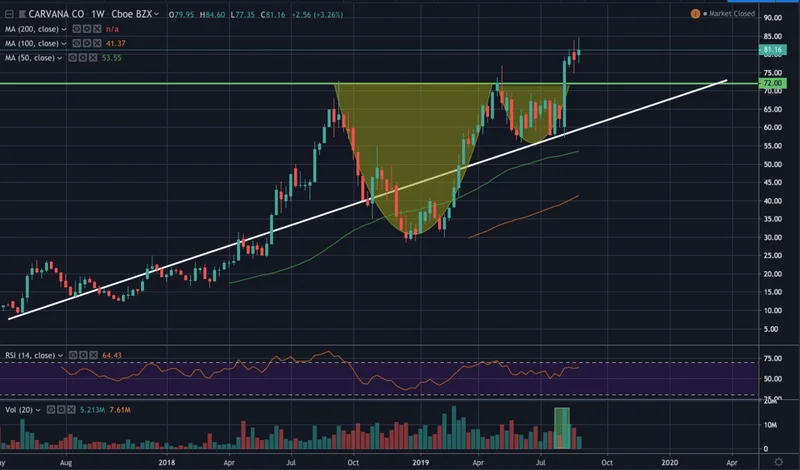
This isn't just a better car dealership; it's a fundamental re-platforming of automotive retail. It’s the same leap we saw when the printing press replaced the scribe. One was an incremental improvement; the other changed the flow of information for all of humanity. Carvana's model, much like that of other disruptors from `tsla` to `pltr stock`, challenges the very foundation of its industry. The `cvna stock price` isn't just reflecting car sales; it's reflecting the market's slow, dawning realization that the old way is officially obsolete.
This Isn't About Cars Anymore
Let’s zoom out. The Q3 report wasn’t a report card; it was a manifesto. It proved that a complex, high-friction, physical-world industry can be completely transformed by a vertically integrated, data-first platform. Carvana didn’t just build a better website; they built a new engine for commerce. The debate is over. The code has been cracked. Now, the only question left is, who's next?
标签: #cvna stock