

Friends, let’s talk about a signal. Not the kind you find in a data stream, but the kind that flashes across the market, telling a story far bigger than the ticker tape suggests. Right now, that signal is coming from a 100-year-old company called Erie Indemnity (ERIE), a bedrock of the insurance world. And the signal is this: its stock has plummeted an astonishing 40% in the last year.
On the surface, this looks like a simple story of failure. A classic case of an old-guard company stumbling in the modern market. You’ll see headlines like Erie Indemnity Stock Tanks 40% – Is This Insurance Play Now a Bargain? and quant models flagging it as a “Strong Sell,” pointing to missed earnings-per-share forecasts and rising costs. And if you’re only looking at the spreadsheet, that’s a fair, if unimaginative, conclusion.
But I’m asking you to look deeper. Because what’s happening to Erie isn’t a story about one company’s quarterly report. It’s a profound, real-time glimpse into a fundamental rewiring of our world. This isn’t a failure; it’s a crucible. We are watching an entire industry—one that underpins our whole society—being forced to reinvent itself against two of the most powerful forces of the 21st century: a chaotic climate and the relentless threat of digital disruption.
The Old Maps Are Burning
For a century, insurance has operated on a simple, elegant principle: the law of large numbers. It used vast archives of historical data to predict the future. Insurers were like master cartographers, drawing detailed maps of risk based on decades of predictable patterns. A fire in this neighborhood, a fender-bender on that street, a hailstorm in this season—it was all charted. Their business model was a fortress built on the bedrock of historical stability.
That bedrock is now cracking.
Look at Erie’s numbers. In the second quarter of 2025, catastrophe losses—that’s insurance-speak for events like hurricanes, wildfires, and freak storms—accounted for a staggering 20.7 points of their loss ratio. Let me put that in simpler terms: for every dollar they took in from certain premiums, a huge chunk was immediately paid out to cover disasters that are growing more frequent and more violent. The old maps didn't predict this. The historical data that powered their algorithms for decades is becoming obsolete. It’s like trying to navigate the Atlantic with a map from 1491; the coastlines have fundamentally changed.
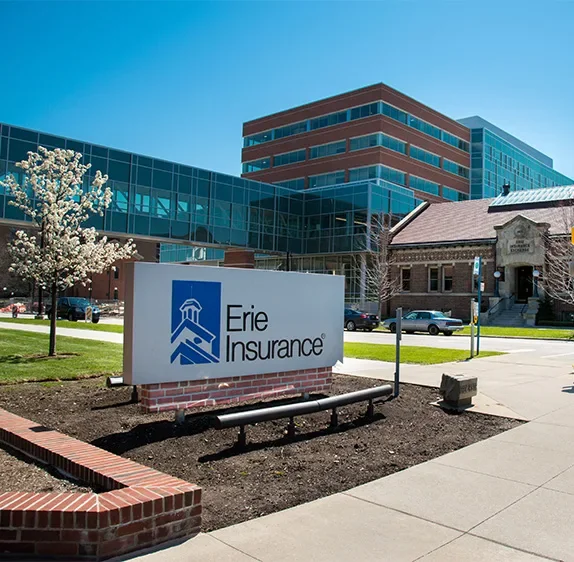
And it’s not just the physical world that’s become unpredictable. In June, Erie suffered a cyberattack that briefly knocked its customer portals offline. While the company reported no material financial damage, the event itself is the critical data point. It represents another vector of risk that simply didn't exist on the old maps. You can't find "ransomware attack" in an actuarial table from 1985. So now, you have a company fighting a war on two fronts: against increasingly ferocious weather in the physical world and against invisible threats in the digital one. Is it any wonder their stock is volatile?
The Price of a Paradigm Shift
This brings us to the market’s reaction. Wall Street sees rising expenses—higher commission payouts and, crucially, increased IT costs—and penalizes the stock. Investors are understandably nervous. But I want you to reframe that. When I see a company's stock get hammered while its IT budget climbs, I don't see failure; I see a company desperately building an ark in the middle of a storm.
Those rising IT costs aren't a bug; they're a feature of survival. Erie is being forced to evolve from a company of statisticians into a company of technologists. They have to build new systems, new predictive models fueled by AI and real-time satellite data, and new cybersecurity defenses that can stand up to nation-state-level threats. The race is on to create a new kind of digital cartography for a world that refuses to sit still, and the sheer speed and complexity of this is just staggering—it means the gap between yesterday's risk and tomorrow's reality is closing faster than any of us can truly comprehend.
This is the kind of breakthrough that reminds me why I got into this field in the first place. We're not just watching a financial story unfold; we're seeing the birth of a new science of survival. Can an algorithm predict the path of a wildfire with enough accuracy to save a town? Can a machine learning model detect a cyber intrusion before it cripples critical infrastructure? These are the questions Erie and its peers are now forced to answer. Their stock price isn't just a reflection of their quarterly profits; it's a barometer of their progress in this existential race.
And this is where we have a moment of profound responsibility. The tools being built—the AI, the data models—aren't just for protecting a company's bottom line. They are becoming essential for protecting our homes, our businesses, and our communities. Getting this right isn't optional. It’s a societal imperative.
This Isn't a Stock, It's a Stress Test
So, as Erie prepares to release its third-quarter results on October 30th, the world will be watching. The company has scheduled a follow-up call, as announced in Erie Indemnity to Host Third-Quarter Webcast Oct 31, 10 a.m. ET. Analysts expect earnings of around $3.37 per share. But the number itself is almost secondary. The real story will be in the guidance, in the discussion of their strategy. Are they just cutting costs, or are they investing intelligently in the tools of the future? Do they see the world as it is now, or are they still navigating with those old, burning maps?
Don't mistake the 40% drop for a sign of death. It is a violent, painful, but necessary sign of life and transformation. We are watching an entire industry, a foundational pillar of our economy, undergoing a system-wide reboot in real time. The volatility you see in ERIE's stock is the friction of that change. It's messy, it's scary, and it's absolutely fascinating. This isn't just an investment thesis; it's a front-row seat to the future being forged.
标签: #erie insurance