

In the world of deep tech, capital isn't just a resource; it's a statement. For a company like Quantum Computing Inc. (Nasdaq: QUBT), which operates on the bleeding edge of physics and computation, a cash infusion is a signal flare fired into the night sky of the market, meant to declare viability, ambition, and a future that is arriving faster than anticipated. The company’s recent announcement of a $750 million oversubscribed private placement is one of the brightest flares we’ve seen in this sector. But as any analyst knows, you don’t watch the flare itself—you watch the shadows it casts. Quantum Computing Inc. Announces $750 Million Oversubscribed Private Placement of Common Stock Priced at the Market Under Nasdaq Rules.
The initial market reaction was textbook euphoria. On October 3rd, the QUBT stock price rocketed up by 23.22%, closing at $24.62. This is the kind of surge that lights up trading forums and fuels narratives of the next big thing, the next Nvidia (NVDA) in the making. The money was real, the institutional backing from existing shareholders was a powerful vote of confidence, and the company’s pro-forma cash position ballooned to an estimated $1.55 billion. CEO Dr. Yuping Huang stated this provides sufficient funding through 2028. On paper, it’s a perfect story.
Then came the correction. In pre-market trading on October 6th, the stock promptly shed nearly 9% of its value. This wasn't a panic sell-off; it was a quiet, clinical recalibration. It was the market taking a breath and asking a simple, cold question: what does this money actually buy? The whiplash between the explosive rally and the immediate pullback is the real story here. It represents the fundamental tension at the heart of the entire quantum industry—a collision between a spectacular, world-changing vision and the brutal, near-term economics of turning that vision into a profitable enterprise. Quantum Computing Inc. (QUBT) Stock:Drop 10% in Premarket as $750M Private Placement Fuels Growth Ambitions.
The Anatomy of a Capital Injection
Let’s break down the numbers. The deal involves the sale of 37,183,937 shares of common stock. This brings QCi’s total capital raised since November 2024 to $1.64 billion. For a company in a sector still largely considered pre-commercial, this is an astonishing war chest, placing QCi’s balance sheet among the strongest in the publicly traded quantum space, rivaling the cash positions of more established players like IonQ. The funds are earmarked for the usual slate of growth initiatives: commercialization, strategic acquisitions, volume production, and personnel expansion.
Dr. Huang’s statement is particularly telling. He says the focus now shifts from being a "quantum technology innovation company to a leading quantum hardware manufacturer." This is the most difficult pivot in the entire tech landscape. It's like an architectural firm that has spent a decade designing the world's most beautiful, complex skyscraper suddenly having to become the construction company that actually builds it. The skill sets, the logistics, the risk profiles—they are entirely different. Innovation is about possibilities; manufacturing is about yields, margins, and supply chains. The $750 million is the fuel for this transition, but fuel doesn't guarantee a successful journey.
And this is the part of the announcement that I find genuinely puzzling. The offering was led by the company's largest existing shareholders. While this is presented as a validation, it also raises questions. Why a private placement instead of a broader public offering? Were these terms particularly favorable to insiders? Without full transparency on the participants and the exact pricing mechanism "at the market under Nasdaq rules," we're left to speculate. What do these investors know about the company's technological milestones that the broader market doesn't? Or are they simply doubling down on a high-risk bet, hoping to corner a significant stake before a potential breakthrough?
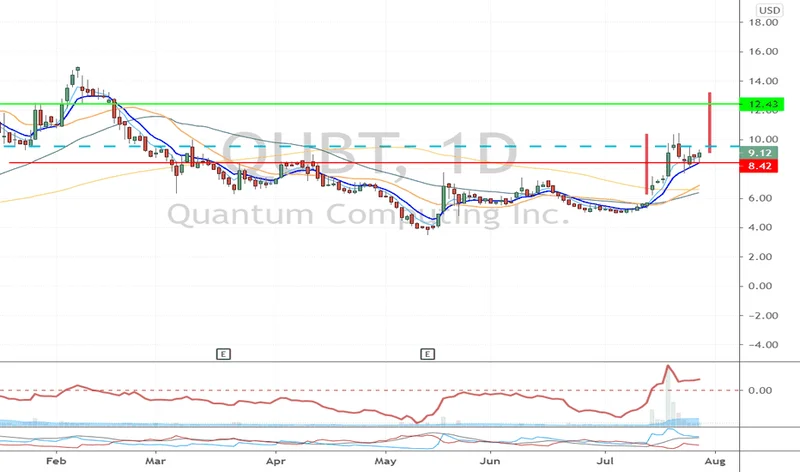
The market's enthusiasm for anything related to next-generation computing, from Nvidia stock to more speculative plays like Palantir (PLTR stock), has created an environment where massive capital raises are possible. But capital is also a burden. It starts a clock. Every dollar added to the balance sheet comes with an implicit expectation of a return, and for QCi, that clock is now ticking very, very loudly.
A Market Divided
The stock's behavior—a 23% surge followed by an 8.77% pre-market drop, to be more exact—is a perfect microcosm of investor psychology in a speculative field. The initial spike was driven by algorithms and headline-readers seeing "$750 million" and "oversubscribed." It’s a purely quantitative signal of confidence. The subsequent dip reflects the qualitative analysis kicking in, as investors digest the dilution (the issuance of over 37 million new shares) and the long, uncertain road ahead.
This isn't a company like Tesla (TSLA), which, despite its volatility, sells hundreds of thousands of tangible products each quarter. QCi is selling a promise. Its technology—integrated photonics and thin-film lithium niobate—is compelling because it aims for room-temperature, low-power quantum machines. This would be a genuine game-changer, sidestepping the massive cryogenic cooling infrastructures required by many competing quantum modalities. It’s an elegant solution, but it is not yet a mass-produced one.
The company's stated goal is to "put quantum into the hands of people." It's a noble mission, but what is the pragmatic timeline? The funding runway to 2028 is a comforting metric, but it’s also an admission that meaningful, consistent profitability is at least four years away, and likely more. How much of that $1.55 billion will be consumed by R&D burn versus the capital expenditures needed for "volume production"? The details on this strategic allocation remain vague. We know the destination, but the map is still being drawn. This uncertainty is what gives pause to the more discerning investor, creating the sell-off that shaved the top off the initial rally.
A Calculated Gamble, Not a Guaranteed Outcome
Let's be clear: Quantum Computing Inc. just executed a brilliant financial maneuver. Securing this level of non-dilutive funding (relative to debt) at this stage is a massive strategic win. It provides them with the two things a deep-tech company needs most: time and resources. They now have a formidable moat of capital that insulates them from market downturns and allows them to pursue an aggressive growth strategy without existential funding pressure for the next few years.
But the cash is an enabler, not a conclusion. The market's initial euphoria followed by a sober correction is the correct and rational response. The $750 million is a down payment on a future that is still highly speculative. QCi has bought its ticket to the hardware manufacturing race. It has the fuel in the tank. Now, it has to prove it can build the engine, fly the ship, and stick the landing. The balance sheet looks incredible today, but the only numbers that will ultimately matter are the ones that eventually appear on the income statement. And those remain, for now, a quantum uncertainty.
标签: #qubt stock