

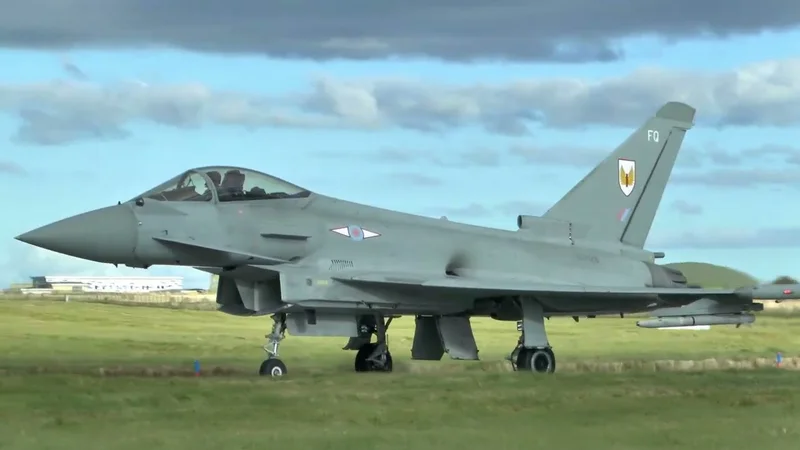
On Tuesday, September 30, 2025, two Eurofighter Typhoon jets executed a standard Quick Reaction Alert (QRA) launch from RAF Lossiemouth. The operational trigger was an unidentified aircraft transiting the North Sea, approaching what the Ministry of Defence terms the "UK's area of interest." The event concluded without an intercept; the target aircraft never entered the UK's formal Flight Information Region.
The Typhoons were supported by an RAF Voyager tanker, callsign TARTAN21, which provided an air-to-air refuelling capability west of the Shetland Islands before all assets returned to their respective bases. An RAF spokesperson confirmed the details in a statement that was as brief as it was predictable: an aircraft was monitored, it did not require interception, and the mission was a success.
Online, the reaction was equally predictable. A recurring sentiment, observable across multiple forums, is that these scrambles "happen all the time." This observation is, on a surface level, correct. QRA is a continuous, 24/7/365 air defence posture. Yet, the statement masks a fundamental misinterpretation of the data. The public awareness of these events is not an indicator of their frequency, but rather a function of their visibility. Each scramble is a discrete data point, but focusing on them individually is akin to analyzing a company's health by watching its stock ticker fluctuate second-by-second. It generates noise, not insight.
The September 30th event is a perfect example of this. It was a null event. A system was activated, it performed its function, and it determined no further action was required. From an analytical perspective, it is the equivalent of a server pinging a network and receiving a valid, negative response. The system works. That is the only available conclusion. To find a more instructive narrative, one must look for a more robust data set.
The Scramble is Noise; The Deployment is Signal
A More Instructive Data Set
Five months prior, in April 2025, a detachment of Typhoons from the same base—specifically, II (Army Cooperation) Squadron—was deployed to Malbork Air Base in Poland. This mission, designated Operation Chessman, was part of NATO's long-standing Enhanced Air Policing (eAP) mission. This is a far more useful analytical framework. Unlike a single QRA scramble, a deployed operation provides a series of events over a defined period, allowing for pattern recognition.
The Poland deployment was notable for two primary reasons. First, it marked the operational debut of Swedish Gripen fighters within the NATO air policing structure since Sweden formally joined the Alliance in 2024. The Minister for the Armed Forces, Luke Pollard, correctly noted that the mission "shows our ability to operate side by side with NATO's newest member Sweden." This is a tangible data point on interoperability.
Second, the mission generated actual intercepts. On April 15, RAF Typhoons intercepted a Russian Il-20M intelligence-gathering aircraft (NATO reporting name: Coot-A) that was being escorted by two Su-30S multirole fighters (NATO reporting name: FLANKER-H). Two days later, on April 17, they intercepted another Il-20M. An Expeditionary Air Wing spokesperson later clarified that during this second intercept, the Russian aircraft was not communicating with air traffic control, necessitating a "shadowing" procedure to ensure the safety of civilian air traffic.
Here, we move from the binary outcome of the September scramble (intercept/no intercept) to a richer set of variables. We have specific aircraft types, dates, and operational behaviors. The Eurofighter Typhoon is a twin-engine fighter with a top speed approaching Mach 2—to be more exact, 2,495 km/h at altitude. Its purpose in these encounters is to identify, monitor, and deter. The Russian aircraft, in turn, are testing response times, gathering electronic intelligence, and asserting a presence in international airspace.
This is not a dramatic, cinematic dogfight. It is a highly professional, calculated, and repetitive interaction. And this is the part of the data that I find genuinely puzzling in its public portrayal. The narrative often frames these intercepts as moments of high tension, yet the underlying reality is one of routine. These are the daily operations of a strategic policy, specifically NATO's Assurance Measures (a policy framework established in 2014 following Russia's annexation of Crimea). The goal of these measures is deterrence through persistent presence. The intercepts in Poland are not a sign of the policy failing; they are a sign of it functioning exactly as designed.
The September 30th scramble near the UK is a single point on a graph. The April deployment to Poland is a trend line. The former generates headlines; the latter demonstrates strategy. The official statements reflect this. The RAF's comment on the UK scramble was purely factual and operational. Minister Pollard’s statement about Poland, however, was strategic, referencing NATO and alliance cohesion. The two events serve different purposes, both for the military and for the political narratives built around them.
The public sentiment that these events "happen all the time" is therefore both right and wrong. The system of readiness is constant. The logistical tail—the Voyager tankers from RAF Brize Norton, the ground crews at RAF Lossiemouth, the command and control infrastructure—is always active. A scramble is merely the most visible kinetic output of that vast, and very expensive, system. It is the part of the iceberg that breaks the surface. The real work, the real measure of commitment, is the constant, attritional effort of deployments like Operation Chessman, conducted far from the public eye. Focusing on the scramble is like judging a factory's output by only ever watching the loading dock door open and close. You see activity, but you have no quantifiable sense of productivity or purpose.
---
An Exercise in Baseline Normalization
The salient metric is not the number of times jets are scrambled from Lossiemouth. That number is reactive, driven by external stimuli, and tells us more about Russian flight patterns than it does about UK or NATO capability. The truly meaningful data points are found in the operational tempo of planned deployments, the successful integration of new allies like Sweden, and the consistent funding required to maintain this posture. The public narrative is calibrated to respond to the alarm bell of a QRA launch, but the real story is the quiet, methodical, and continuous cost of keeping the system ready to respond at all. The alarm is not the story; the readiness is.
Reference article source: